
What flour is used for authentic Italian fresh pasta?
When people try to make fresh pasta at home outside of Italy, they often grab whatever flour is in the pantry, crack an egg into it, and hope for the best. Sometimes it works out, but often the dough is tough, dense, or tears easily.
The secret to that silky, perfect bite you get in a Tuscan trattoria isn’t a complex recipe. It’s using the right flour.
In Italy, there are two main flours used for pasta, and they each serve a very specific purpose.
1. Type “00” Flour (Farina 00) - For Fresh Egg Pasta
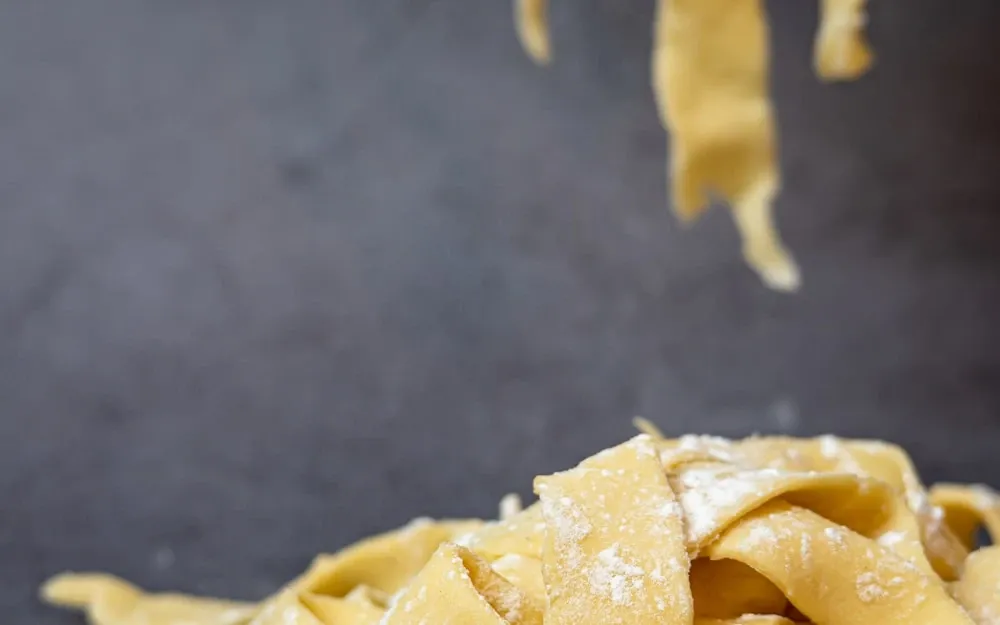
If you are making fresh egg pasta shapes like pappardelle, tagliatelle, ravioli, or tortelli you need Type 00 flour.
“00” (pronounced doppio zero) does not refer to the protein content of the flour, but rather to how finely it is milled. The Italian grading system goes from 2 (coarse and whole wheat) down to 00 (the finest, whitest flour).
Because 00 flour is milled so finely, it feels almost like talcum powder. When combined with the fat and protein from fresh eggs, it creates a dough that is incredibly silky, elastic, and smooth. This elasticity is crucial when you are trying to roll the dough out into a sheet so thin you can read a newspaper through it.
Can you use All-Purpose flour? Yes, but your pasta won’t be as delicate. All-purpose flour has a slightly coarser grind and usually a different protein profile, leading to a dough that is slightly chewier and harder to roll out completely thin.
2. Semolina Flour (Semola di Grano Duro) - For Water Pasta
If you are making a southern Italian shape like orecchiette or a rustic Tuscan shape like pici, you leave the eggs in the fridge. For these, you need Semolina flour and warm water.
Semolina is milled from hard durum wheat (grano duro). It has a pale yellow color and feels much coarser, almost like fine sand. Because durum wheat is very hard and high in gluten-forming proteins, it creates a very strong, structured dough even without the binding power of eggs.
Pasta made with semolina has a fantastic, hearty chew to it. It also has a rougher surface that grips onto thick, rustic sauces brilliantly.
Note: You will also often see pasta makers dusting their wooden boards with semolina flour when rolling out 00 egg dough. Because semolina is coarse and dry, it acts like tiny ball bearings, preventing the fresh egg pasta from sticking without being absorbed into the dough.
The Perfect Blend
In some regions (and even in our own kitchen depending on the humidity and the shape we are making), pasta makers will blend the two. A common mix is 70-80% 00 flour and 20-30% fine semolina (semola rimacinata). This gives you the silky workability of the 00 flour, with just a bit of the structural bite and yellow hue of the semolina.
Get your hands in the flour
Reading about flour is one thing; feeling the dough transform under your hands is entirely different.
If you want to feel exactly what the perfect 00 egg dough feels like when it is perfectly kneaded, come join one of our pasta making classes in Florence. We’ll measure out the flour on a wooden board, crack the eggs, and teach you how to bring it all together by hand.
Frequently asked
What is the best flour for fresh pasta?
The best flour for fresh egg pasta (like tagliatelle and ravioli) is '00' (doppio zero) soft wheat flour. For eggless pasta (like pici or orecchiette), semolina flour (semola di grano duro) is used.
Can I use all-purpose flour for pasta?
You can use all-purpose flour in a pinch, but it lacks the ultra-fine milling of 00 flour, meaning your pasta won't be quite as silky or smooth.
What makes 00 flour different?
00 refers to the milling grade in Italy. It is the finest grind possible, feeling almost like talcum powder. It produces a very silky, stretchy dough perfect for delicate egg pasta.
Rather learn it with your hands?
Roll, fold and eat it yourself: in our Florence kitchen or live online.