
Ravioli vs tortelli vs tortellini: the difference
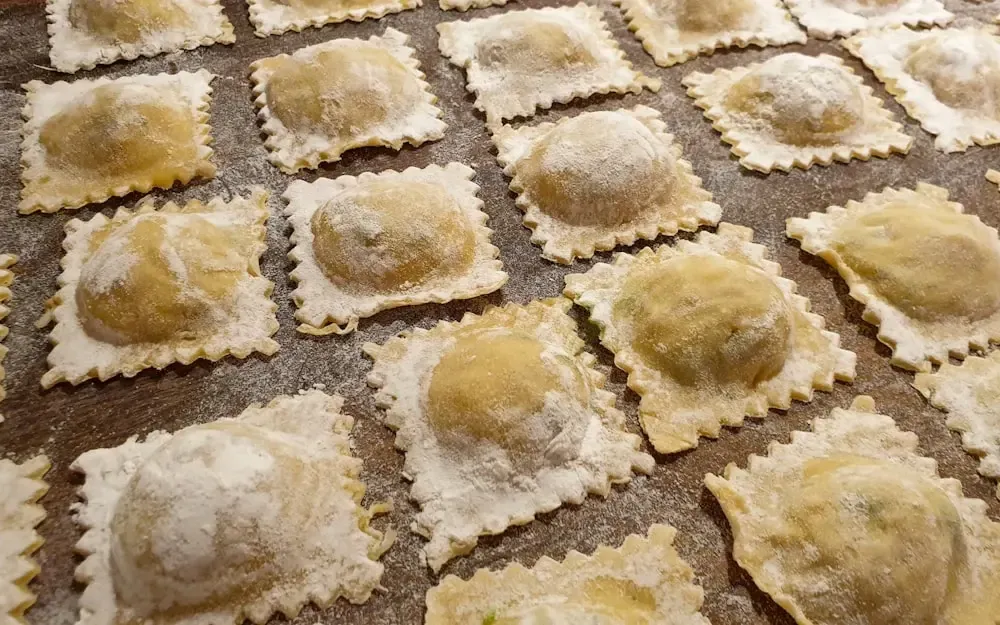
Short answer: ravioli and tortelli are the same idea under two names. Both are fresh pasta filled with something and sealed between two sheets. Ravioli is the broad, national word. Tortelli is what we call them in Tuscany and Emilia, and ours are usually bigger.
The longer answer is more interesting, because the naming tells you where you are standing.
The one rule that actually holds
Italian filled-pasta names are regional first and descriptive second. There is no national standards body for this, and any Italian who tells you their region’s definition is the correct one is doing it affectionately rather than accurately.
That said, here is the working map:
| Name | Shape | Size | Home | Usually served |
|---|---|---|---|---|
| Ravioli | Flat square or round, two sheets sealed | Small | The general Italian term | With sauce |
| Tortelli | Square or half-moon | Larger | Tuscany, Emilia | With sauce |
| Tortellini | A ring, folded round a fingertip | Tiny | Bologna | In broth |
| Agnolotti | Rectangular pinched pocket, often one sheet folded | Small | Piedmont | With roast juices or butter |
| Cappelletti | ”Little hats”, a ring with a peak | Small | Romagna, Le Marche | In broth |
If you remember only one thing: tortellini go in broth and are tiny; everything else is bigger and gets sauce.
Ravioli or tortellini, in one line
This is the question people actually ask, and the one that gets answered worst, because tortelli and tortellini sound almost identical and are two different things.
Tortellini are rings. A small filled square is folded around a fingertip and the two ends are pressed together, closing it into a ring. They are tiny, about the size of a thumbnail, they come from Bologna, and they belong in broth. The filling is meat: pork loin, mortadella, prosciutto.
Ravioli are flat. A mound of filling between two sheets, sealed all round, cut square or round. Much bigger than a tortellino, served with sauce, filling depending on the region.
So the difference is not the filling and not the dough. It is the fold, and what happens next: a ring in broth versus a flat parcel with sauce.
And tortelli, which is what this article is actually about, are not large tortellini despite the name. They are flat parcels like ravioli, only bigger and Tuscan. The -ini ending is a diminutive in Italian, which for once misleads: tortellini are not small tortelli, they are their own shape from a different city.
What makes Tuscan tortelli different
Here is the part visitors do not expect. Ask for tortelli in the Mugello, the hill country north of Florence, and what arrives is filled with potato, mashed with garlic, parsley, a little tomato, parmesan and sometimes nutmeg. Not ricotta. Not spinach.
The reason is the reason behind most regional Italian food: potatoes grew well up there and meat did not go far. It is one of the genuinely great dishes of Tuscany and it surprises almost everyone who orders it expecting the ricotta-and-spinach version they know from home.
The other Tuscan version, tortelli maremmani, does use ricotta and spinach and comes from the Maremma on the coast. Both are correct. They are simply from different valleys, and people from each will tell you the other one is a bit odd.
We wrote more about this in the tortelli page of our shapes library, including the folding, and the flatter, smaller version has its own page under ravioli.
The technique is identical, whatever you call it
Whether you are making ravioli in Rome or tortelli in the Mugello, the method is the same, and so are the ways it goes wrong.
Roll the sheet slightly thicker than you would for ribbons. A filled shape has to survive being stuffed, sealed and boiled. Tagliatelle-thin dough tears at the seam.
Lay the filling out in a line with proper gaps. Crowding the mounds is what makes sealing impossible later. A teaspoon each, well spaced.
Push the air out before you seal. This is the whole game. Lay the second sheet over and press down around each mound with your fingertips, working outwards towards the edge so the air escapes rather than getting trapped over the filling. Trapped air expands in boiling water, and that is what bursts a raviolo, not the water, not the pot, not bad luck.
Seal firmly, then check every edge. Cut with a wheel, then run a finger round each one. One weak seam empties the whole parcel into the pan.
Do not drown it in sauce. You have just spent an hour putting the flavour on the inside. Butter and sage (foamed until it smells nutty, with a few crisped leaves) is the classic for a reason. A restrained meat ragù is the Sunday version. Anything louder is competing with your own filling.
So which should you say?
In Tuscany, say tortelli and you will sound like you have been paying attention. Anywhere else, ravioli is understood everywhere and nobody will correct you.
And if you want to make them with your hands rather than read about them, ravioli are one of the two pastas every guest makes in our three-hour class in the Oltrarno, alongside hand-cut fettuccine. It is reliably the shape people are proudest of at the end, mostly because it is the one that takes patience. Bring children if you have them: the family class runs from age six, and folding parcels turns out to be exactly the kind of job a seven-year-old is good at.
Frequently asked
What is the difference between ravioli and tortelli?
Mostly size and region rather than technique. Ravioli is the broad, national term for filled pasta, usually a smaller square sealed between two sheets. Tortelli is what the same idea is called across Tuscany and Emilia, and they are typically larger: a bigger square or half-moon. In Tuscany the classic filling is potato, not ricotta.
Are ravioli and tortellini the same thing?
No. Tortellini are small rings (a filled square folded around a fingertip and joined at the ends), and they come from Bologna, traditionally served in broth. Ravioli are flat parcels sealed between two sheets of pasta and served with sauce.
Are tortellini just small tortelli?
No, even though the -ini ending is a diminutive in Italian and suggests exactly that. Tortelli are flat filled parcels from Tuscany and Emilia, larger than ravioli. Tortellini are folded rings from Bologna. Similar name, different shape, different city.
What is the difference between a raviolo and ravioli?
Only grammar. Raviolo is the singular and ravioli is the plural, the same way panino becomes panini. One raviolo, a plate of ravioli. The same applies to tortello and tortelli, and to tortellino and tortellini.
What are ravioli traditionally filled with?
The most common filling is ricotta with spinach, seasoned with nutmeg and parmesan. Meat, pumpkin, mushroom and, in Tuscany, potato are all traditional depending on the region and the season.
Why do my ravioli burst when I boil them?
Almost always trapped air. Press the top sheet down around each mound of filling with your fingers and work the air outwards before sealing the edge. Under-sealed edges, overfilling, and dough rolled too thin are the other three causes.
Can you learn to make ravioli in Florence?
Yes: every guest in our three-hour class in the Oltrarno makes ravioli by hand, filled, sealed and served with butter and sage. Tortelli are the same technique made larger, and the filled pasta is the shape most guests are proudest of at the end.
Keep readingMore guides from our kitchen
- Tagliatelle vs pappardelle: how wide is each ribbon?Tagliatelle is cut 6–8 mm wide, pappardelle 20–30 mm. Same egg dough, different knife, and a completely different job on the plate.
- Tuscan pasta shapes: pici, pappardelle, tortelli & moreA chef’s guide to Tuscany’s classic fresh pasta types: where each shape comes from, how it’s made by hand, and the sauce it was born to carry.
Rather learn it with your hands?
Roll, fold and eat it yourself: in our Florence kitchen or live online.