
Tagliatelle vs pappardelle: how wide is each ribbon?
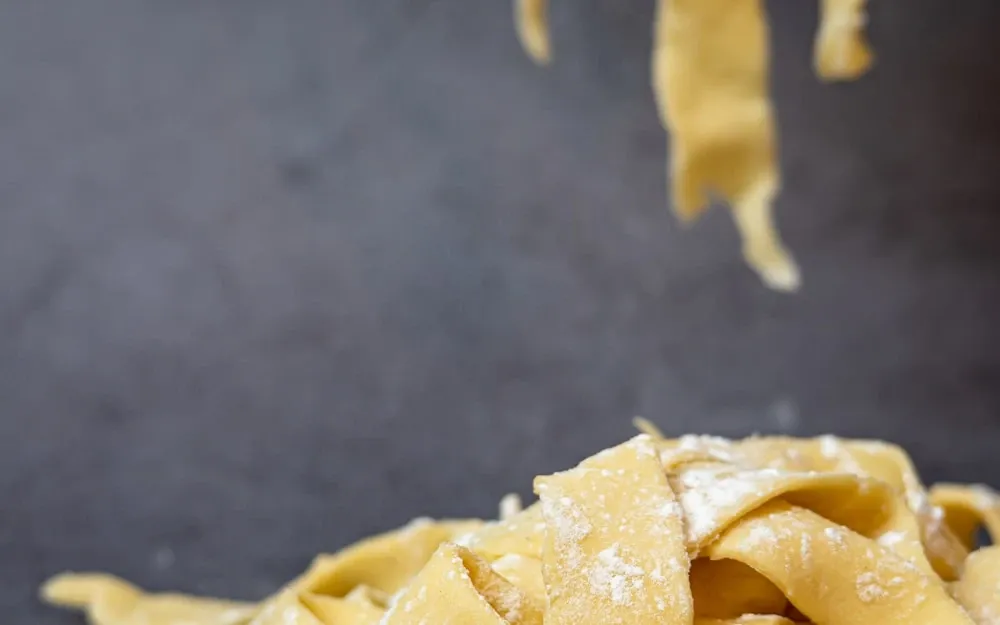
Short answer, with the numbers: tagliatelle is cut 6–8 mm wide, pappardelle 20–30 mm. Same egg dough, same rolling, same pot. The only difference is where you put the knife, and that difference decides which sauce works.
I cut both most days, so let me be more useful than “one is wider”.
Every Italian ribbon, by width
| Ribbon | Width | Home | Built for |
|---|---|---|---|
| Tagliolini | ~2 mm | Piedmont, Liguria | Broth, butter, seafood |
| Fettuccine | ~6 mm | Rome | Butter and cheese, thicker than it looks |
| Tagliatelle | 6–8 mm | Bologna, Tuscany | Meat ragù, porcini |
| Pappardelle | 20–30 mm | Tuscany | Wild boar, hare, duck |
| Lasagne | Sheet, uncut | Everywhere | Layered, baked |
That is the whole family. They are all pasta a nastro, ribbon pasta, and they are all the same dough. If someone hands you a plate and you are not sure what you are looking at, measure it with your eye against your finger: a finger is about 15 mm, so pappardelle is noticeably wider than one and tagliatelle is half of one.
How wide is pappardelle, really?
Two to three centimetres. Two fingers.
Tuscans are not precious about the exact number, and you will find kitchens cutting anywhere from 20 to 30 mm, but the shape stops being pappardelle somewhere around 15 mm. Below that you have made wide tagliatelle, which is a fine thing to have made, just not this.
The name comes from pappare, to gobble. It is a Tuscan verb and it is not polite. Nobody named this pasta after the ribbon; they named it after what happens when the boar ragù arrives.
How wide is tagliatelle, really?
6 to 8 mm, and Bologna will give you the exact figure whether you asked for it or not.
There is a brass rule deposited at the Bologna chamber of commerce that fixes the ideal cooked tagliatella at 8 mm. Cooked is the operative word: egg dough takes on water and swells, so you cut at roughly 6 to 7 mm raw to land at 8 mm on the plate.
You do not need the brass rule. You need to cut consistently, because ribbons of different widths cook at different speeds and you end up with some al dente and some soft in the same forkful.
Why the width is not a decoration
A sauce has to have something to hold on to, and the amount of surface a ribbon offers changes what will stay on it.
A wild boar ragù is chunky. The pieces of meat need a flat surface broad enough to sit on, or they part company with the pasta and settle at the bottom of the bowl, which is how you end up eating plain pasta first and a puddle of sauce last. That is what the 30 mm is for.
A finer ragù, or porcini in butter, does not need that much landing area, and on a ribbon that wide it looks lost. Tagliatelle gives it the right ratio.
This is the entire logic of Italian pasta shapes, and it is worth internalising because it makes every future decision obvious: the chunkier the sauce, the more surface it needs. Our shapes library works through the same reasoning for all four shapes we teach.
Cutting them by hand
Roll the sheet, flour it, then fold it loosely into a flat roll about 8 cm across. Do not press the fold; you want it to unroll cleanly.
Then cut across the roll with a sharp knife in one confident motion. Hesitate and you drag the dough and get a ragged edge. For tagliatelle, cut at the width of a pencil. For pappardelle, cut at the width of two fingers.
Unroll immediately, before the ribbons have time to think about sticking to each other, and drop them into loose nests dusted with semolina. Fresh egg ribbons cook in two to three minutes, sometimes less, so have the sauce ready before the pasta goes in and not the other way round.
The one mistake to avoid: rolling the sheet too thin. Ribbons want a little body, especially pappardelle, which has to hold a heavy sauce without tearing. If you can read a newspaper through it, you have gone too far. That thinness belongs to filled shapes like tortelli, and even there it is a mistake.
So which one do you want?
Boar, hare, duck, anything with big pieces in it: pappardelle. Fine meat ragù, mushrooms, butter, anything smooth: tagliatelle.
And if you would rather cut them than read about them, both are in our three-hour class in the Oltrarno, along with pici and tortelli. Rolling the sheet is the part everyone worries about and the part that turns out to be easy; cutting a straight ribbon is the part nobody expects to be hard.
Frequently asked
How wide is pappardelle?
Pappardelle is cut between 20 and 30 mm wide, so roughly two to three centimetres, about the width of two fingers. It is the widest of the Italian ribbon pastas short of a lasagne sheet. Anything narrower than about 15 mm is closer to a tagliatella than a pappardella.
How wide is tagliatelle?
Tagliatelle is cut 6 to 8 mm wide. Bologna is precise about it: a brass rule held at the city's chamber of commerce fixes the ideal cooked tagliatella at 8 mm, which means cutting it at roughly 6 to 7 mm raw, because egg dough swells in the pot.
What is the difference between tagliatelle and pappardelle?
Width, and therefore the sauce. They are made from the same egg dough and rolled the same way; the only difference is how wide you cut the sheet. Tagliatelle at 6–8 mm suits finer meat ragù and mushrooms. Pappardelle at 20–30 mm is built to carry heavy game sauces like wild boar and hare.
What is wide ribbon pasta called?
The wide flat ribbons are pappardelle at 20–30 mm. Below them come tagliatelle at 6–8 mm, fettuccine at about 6 mm, and tagliolini at around 2 mm. All four are ribbon pasta, or pasta a nastro in Italian; they differ only in width.
What does pappardelle mean?
It comes from the Tuscan verb pappare, to gobble or wolf something down. The name is a compliment to the sauce rather than a description of the shape, which tells you most of what you need to know about how the pasta is meant to be eaten.
Can I use tagliatelle instead of pappardelle?
You can, but a heavy chunky ragù will slide off the narrower ribbon and pool at the bottom of the bowl. If you are cooking wild boar, hare or duck, cut the sheet wide. If the sauce is fine or creamy, cut it narrow.
Rather learn it with your hands?
Roll, fold and eat it yourself: in our Florence kitchen or live online.