
Team Building in Florence: 8 Formats That Work
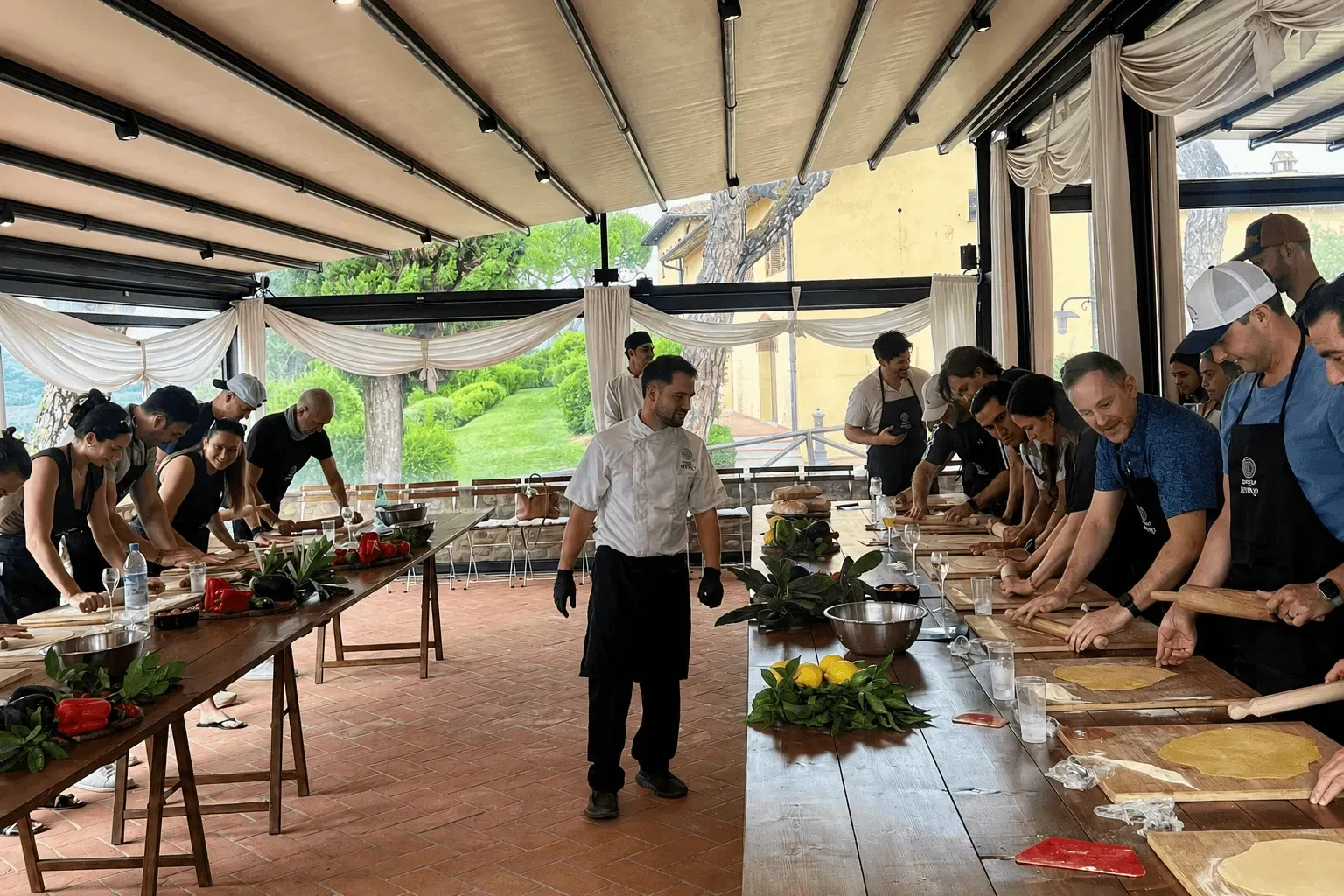
I have hosted a lot of corporate groups in our kitchen, and I have also watched teams arrive straight from something that did not work. So this is the honest version: what actually loosens a team up in Florence, what looks good in a proposal and dies in practice, and how to choose by the thing that decides everything, which is group size.
What makes team building in Florence actually work?
Three things, and none of them is the activity itself.
- Everyone has to be doing something with their hands. The moment an activity splits into participants and spectators, the quiet people go quiet. This is the single biggest predictor I see.
- Nobody can be bad at it in front of colleagues. Anything with a scoreboard rewards the confident and isolates everyone else. A senior manager visibly worse at the task than a junior is good for a team; a junior humiliated in front of the room is not.
- It has to end sitting down, together, with food. The bonding does not happen during the activity. It happens in the forty minutes afterwards, and if there is no natural place for that, you paid for half an event.
Florence is unusually good for this because the city is small. You can walk between almost anything inside the historic centre in twenty minutes, so you can stack two things into one afternoon without a coach transfer eating the budget.
Team building in Florence by group size
6 to 14 people: a private kitchen
A hands-on cooking session is the format I would pick even if I were not a chef, for the three reasons above: everyone works, nobody can lose, and it ends at a long table. Fresh pasta in particular works because the skill curve is flat. Nobody in the room arrives with an advantage, the CFO is exactly as bad at folding ravioli as the new hire, and there is something quietly levelling about that.
The limit is the room. Above fourteen people in one kitchen you stop cooking and start queueing, which is why we cap it there rather than selling a number we cannot actually teach. That is what our team building cooking class in Florence is: a private buyout of the Oltrarno kitchen, two English-speaking chefs, and a long lunch of what the team made.
15 to 25 people: a Tuscan estate
Past fifteen you want space more than you want a city address. A working agriturismo in the hills gives you a courtyard, a garden to pick from, and room for people to drift into small groups, which is where colleagues actually talk. Budget forty minutes each way from Florence and treat the drive as part of the day rather than as a cost. Our own agriturismo kitchen in Tuscany runs to twenty.
25 to 60 people: split the group, share the table
The mistake at this size is looking for one activity that holds everyone. There isn’t one. Run two or three parallel tracks for ninety minutes, then bring everybody together for a single long meal. Teams remember the meal; the tracks are mostly the excuse to arrive at it with something to talk about.
60 and up: a venue problem, not an activity problem
At this scale you are booking a space and a caterer, and the team building is whatever can be run in a room that size. Be honest about that during planning rather than buying an activity that quietly becomes a show with sixty spectators.
The eight formats, and how well each one travels
1. Cooking together. Hands busy, no losers, ends in a meal. The strongest all-rounder for mixed seniority and mixed languages, because a chef can demonstrate rather than explain, and a demonstration works in any language.
2. A market tour, then cooking. Adds a walk, some air and something to look at before the hands-on part. Good for a team that has been in a conference room since Monday. Ours goes through Sant’Ambrogio market. Best kept small: twenty people following one guide through a working market is a queue, not a tour.
3. Wine tasting in Chianti. Genuinely pleasant, genuinely passive. Works as the second half of a day, rarely as the whole of one, and the value drops fast if a good part of the team does not drink.
4. Artisan workshops in the Oltrarno. Leather, bookbinding, gold leaf, mosaic. The neighbourhood south of the river still has real working workshops, and making a physical object you take home is memorable. Nearly all of them are small, so treat this as a 6-to-12 format or as one parallel track.
5. A themed guided walk. Cheap, flexible at any size, and the weakest bonding of anything on this list. Use it as connective tissue between two better things, not as the event itself.
6. Treasure hunts and escape rooms. They look perfect in a proposal and they are the format I hear the most complaints about afterwards. They introduce a scoreboard, which reintroduces exactly the hierarchy you were trying to dissolve for an afternoon. If your team is already competitive and enjoys that, fine. If the goal is a tense team relaxing, choose something else.
7. Cycling or e-bikes in the hills. Excellent for a fit and willing group. One person who cannot keep up will remember the day badly, so ask honestly before you book.
8. A long lunch and nothing else. Unfashionable, and better than half the activities above. If the team is exhausted, book a good table for three hours and stop trying to engineer the bonding.
How much should team building in Florence cost?
Per person for half a day, as a planning range rather than a quote:
- A themed guided walk is the cheapest thing on this list, and priced accordingly.
- A hands-on cooking session sits mid-range, and is usually the best value because the meal is inside the price instead of being a separate line.
- A Chianti estate with transport costs more, mostly because of the coach.
- Anything bespoke for forty-plus people is a venue quote, not an activity price.
Two things reliably destroy a budget that looked fine in the spreadsheet. The first is transport, which is why staying inside Florence is worth real money. The second is buying an activity and a dinner separately when a format that ends in a meal would have covered both.
Five questions to ask before booking anything
I would ask these of any provider, including us:
- What is the real maximum, and what changes at it? Everyone has a number at which the experience quietly degrades. Ask what that number is, not what they will accept.
- Is the space private? Sharing a room with strangers changes a team event completely.
- Who is actually teaching, and in which language? “English available” and “taught in English by the person leading it” are different answers.
- What happens with dietary requirements? If the answer is a separate plate arriving later, someone on your team eats alone at a team event.
- Is the food part of the activity or an add-on? This is the cost question hiding inside the experience question.
Pick the right season
June through August the city is hot and full, and an afternoon outdoors becomes a punishment rather than a reward. May, September and October are the good months. November through March you will have the place largely to yourselves, indoor formats come into their own, and prices are softer. If the offsite date is fixed in July, choose something indoors and air-conditioned without apologising for it.
The short answer
For most teams of six to fourteen visiting Florence: cook something together, indoors, in a private room, and eat it at one long table. It is not the most imaginative answer, but it is the one I have watched work most consistently, and the failure modes of everything else on this list are worse.
If that is the direction you are heading, our team building cooking class is a private kitchen buyout for 6 to 14, five minutes from the Ponte Vecchio, quoted per group. Send us your dates and numbers and we will tell you honestly whether we are the right size for you.
Frequently asked
What are the best team building activities in Florence?
For groups of 6 to 14, a hands-on cooking class in a private kitchen is the strongest all-rounder: everyone works with their hands, nobody can be visibly bad at it, and it ends with the team eating together. Market tours, Oltrarno artisan workshops and Chianti wine estates all work well as a second activity. Treasure hunts and escape rooms look good on paper but reintroduce competition, which is usually the opposite of the goal.
How much does team building in Florence cost per person?
A guided themed walk is the cheapest option. A hands-on cooking session sits mid-range and usually represents the best value, because the meal is inside the price rather than billed separately. A Chianti estate day costs more, mostly because of transport. Groups over 40 are quoted as a venue booking rather than a per-person activity price.
What group size works best for team building in Florence?
Six to fourteen is the sweet spot for a single hands-on activity, because above that people start queueing instead of participating. Fifteen to twenty-five works better at a Tuscan estate with outdoor space. Above twenty-five, run two or three parallel tracks and bring everyone together for one shared meal.
Is a cooking class good for team building?
It is the format I would choose even if I were not a chef. Fresh pasta has a flat skill curve, so nobody arrives with an advantage and nobody can lose in front of colleagues, and it finishes at a table, which is where the actual bonding happens rather than during the activity itself.
When is the best time of year for a corporate event in Florence?
May, September and October. June to August is hot and crowded, which makes outdoor formats a punishment rather than a reward, so choose something indoors and air-conditioned if your date is fixed in summer. November to March is quiet and cheaper, and indoor formats come into their own.
Keep readingMore guides from our kitchen
- Things to do in the Oltrarno, Florence: a local guideHow to spend a day in the Oltrarno: Santo Spirito, Palazzo Pitti and Boboli, artisan workshops, and where the evening actually happens.
- What to Eat in Florence: a Tuscan Cook's GuideThe dishes that are genuinely Florentine, the pasta shapes that are Tuscan, and the famous Italian plates that come from somewhere else entirely.
Rather learn it with your hands?
Roll, fold and eat it yourself: in our Florence kitchen or live online.